
Luxury Decor for Small Apartment
Walk into a beautifully designed small living room and you feel something unexpected: expansiveness. Not despite the size, but because of how the space has been handled. Nothing is fighting for attention. Everything has a reason to be there. The air feels like it belongs to you.
Now walk into a cramped small living room — usually the result of too much furniture, too many objects, and a desperate attempt to make a small space feel “full.” It feels exactly like what it is: a room that’s apologizing for itself.
The difference between those two rooms isn’t square footage. It’s intention.
That’s the central idea behind curating a small living room well. You’re not decorating around a limitation. You’re designing with one — and that constraint, handled correctly, produces something more considered and more beautiful than many larger rooms ever achieve.
The Mindset Shift: Curation Over Compromise
The first thing to let go of is the idea that a small living room is a problem to solve. It isn’t. It’s an editing exercise — and editing is a skill that produces better results than abundance ever does.
Why Small Spaces Reward Intentionality
A large room can absorb mediocre choices. A sofa that’s the wrong scale, a rug that’s slightly too small, artwork hung a little too low — in a big room, these things get lost. In a small room, every decision is visible and every mistake is amplified. Which means every right decision is amplified too.
The practical implication: you need fewer pieces, but they need to be better ones. A small living room is the most powerful argument for buying less and buying well.
Less Furniture, More Breathing Room
The instinct when furnishing a small space is to fill it — to prove that the room can hold a sofa and two armchairs and a coffee table and side tables and a console and a bookshelf. It can hold all of that. But it will feel suffocating.
Negative space — the empty areas in a room — is not wasted space. It’s breathing room. It’s what allows the eye to rest, what makes individual pieces read as intentional rather than incidental, and what creates the feeling of calm that you actually want in your home.
The rule of thumb: remove one piece of furniture from whatever you were planning. Then see how the room feels. More often than not, it feels better.
The Editing Principle: Every Piece Must Earn Its Place
Before anything goes into a small living room — furniture, objects, art, plants — it should pass a single test: does this earn its place?
A piece earns its place by being beautiful, functional, or preferably both. A sofa earns its place. A side table that holds a lamp earns its place. A decorative object that adds nothing visually and serves no function does not earn its place in a small room.
This is the discipline that separates a curated small space from a cluttered one. Not minimalism for its own sake — warmth and personality are absolutely welcome — but intentionality. Every single thing in the room should be there on purpose.
Layout Principles for Small Living Rooms
Once you have the mindset, the practical decisions become much clearer. Here’s what the layout principles look like in a small room.
Float Furniture Away From Walls
This is the most counterintuitive principle in small space design, and the most consistently correct one. The instinct is to push everything against the walls to “make more room.” What this actually does is create a ring of furniture around an empty center — and it makes the room feel smaller, not larger.
Floating furniture — pulling the sofa and chairs slightly away from the walls, toward the center of the room — does two things. It creates a sense of depth by allowing negative space between the furniture and the wall. And it makes the furniture arrangement feel like a deliberate decision rather than a default.
The sofa doesn’t need to be far from the wall — even six to twelve inches makes a significant visual difference. Try it in your own room before dismissing it. The result almost always surprises people.
Use One Large Rug Instead of No Rug or a Small One
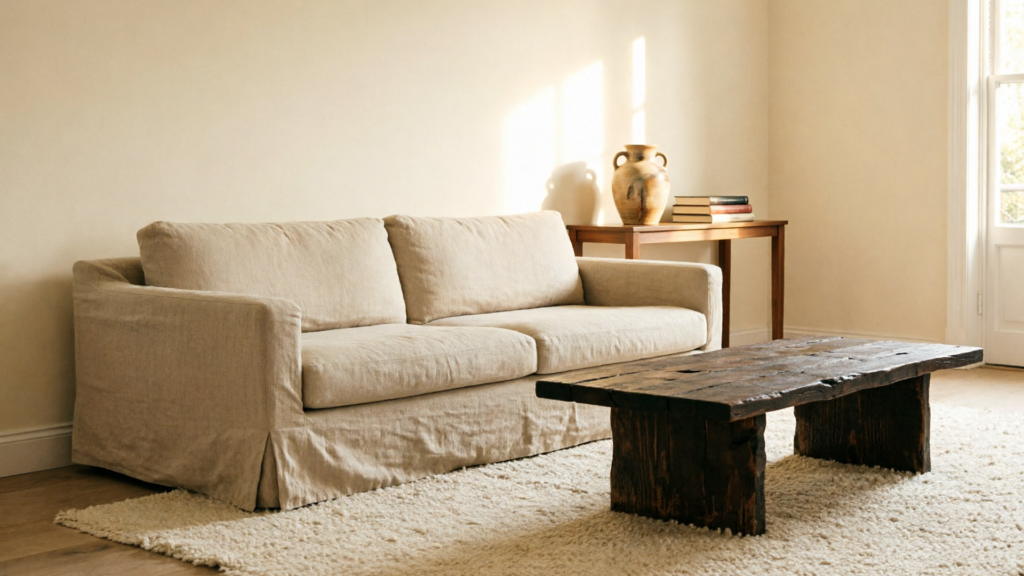
Small rooms consistently suffer from one of two rug mistakes: no rug at all, or a rug that’s too small. Both make a room feel more cramped, not less.
A rug that’s too small floats in the middle of the furniture grouping without anchoring anything — it looks like an afterthought, and it visually chops the room into disconnected pieces. No rug at all leaves the floor as dead space and removes the warmth that makes a room feel livable.
The solution is one large rug — large enough that at least the front legs of every piece of furniture sit on it. This anchors the seating area into a cohesive zone, makes the room feel intentionally composed, and paradoxically creates a sense of spaciousness by defining the space clearly.
In a small room, a rug that feels slightly too large is almost always better than one that feels slightly too small.
Create a Clear Focal Point
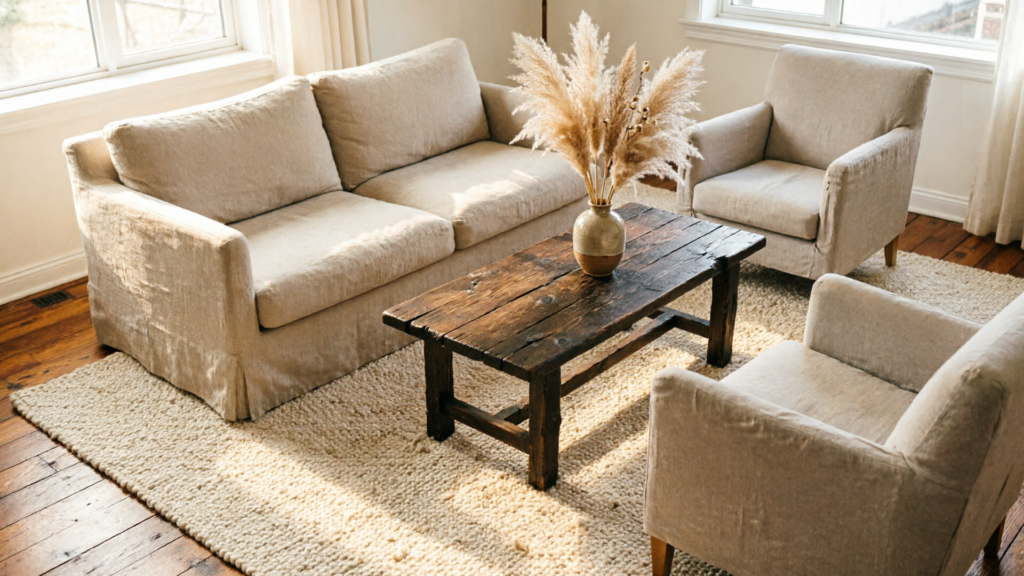
Every room needs something to look at — a visual anchor that tells the eye where to land when you walk in. In a large room, you can have multiple focal points. In a small room, you need one clear one, and everything else should support it.
The focal point might be a fireplace, a piece of art, a beautiful window, or a well-styled bookshelf. Whatever it is, arrange your furniture to face it, keep the competing visual elements around it minimal, and let it do its job.
A room without a focal point feels directionless. A room with one feels resolved.
Use Vertical Space for Storage and Visual Height
In a small room, the floor space is limited — but the vertical space often isn’t. Using it well creates two effects: it provides storage without eating into floor area, and it draws the eye upward, making the room feel taller.
Tall bookshelves, art hung higher than feels intuitive, floor-to-ceiling curtains hung close to the ceiling line, and plants that grow vertically rather than spreading outward — all of these work with vertical space in ways that make a small room feel genuinely larger.
Furniture Choices That Help
Not all furniture works equally well in small spaces. The pieces that tend to fail are visually heavy — they take up the psychological space of the room even when they don’t take up that much physical space. The pieces that work best create visual lightness.
Sofa With Legs
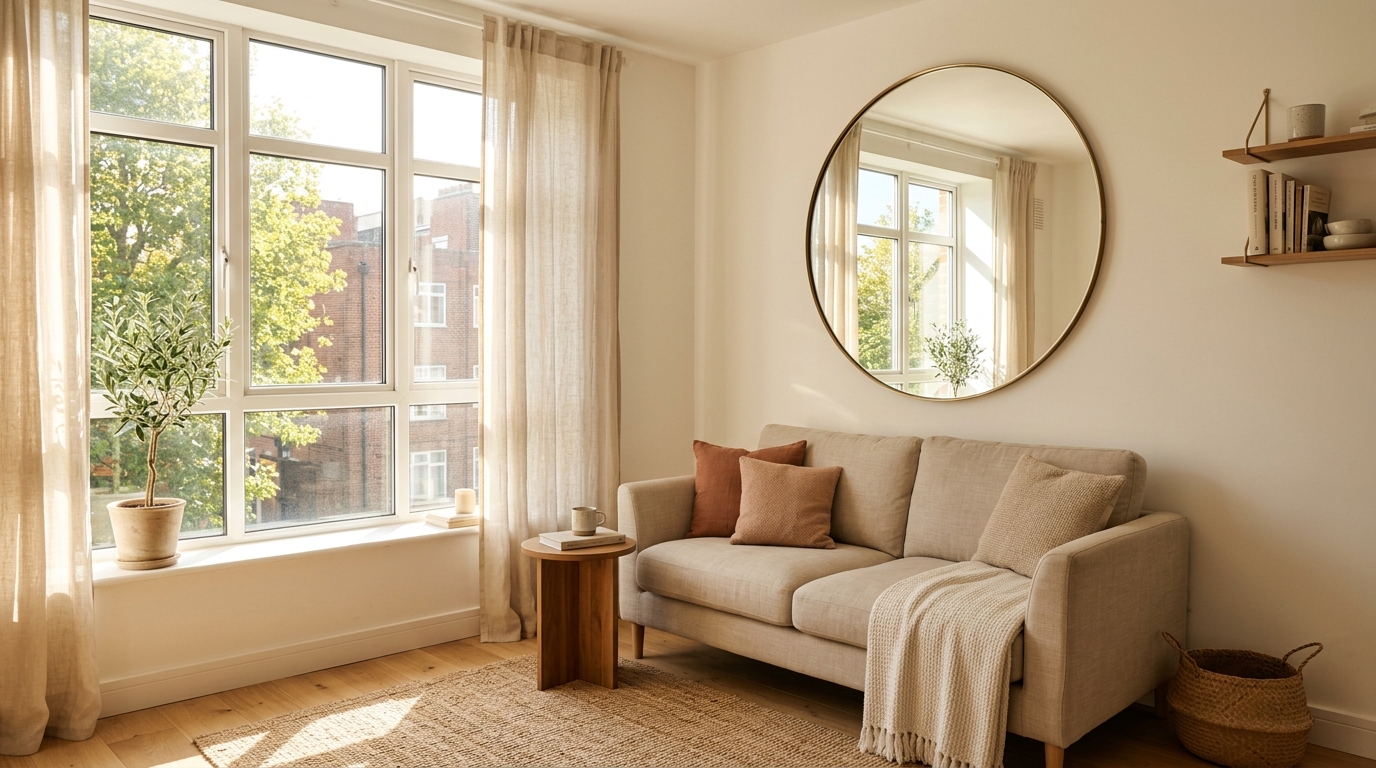
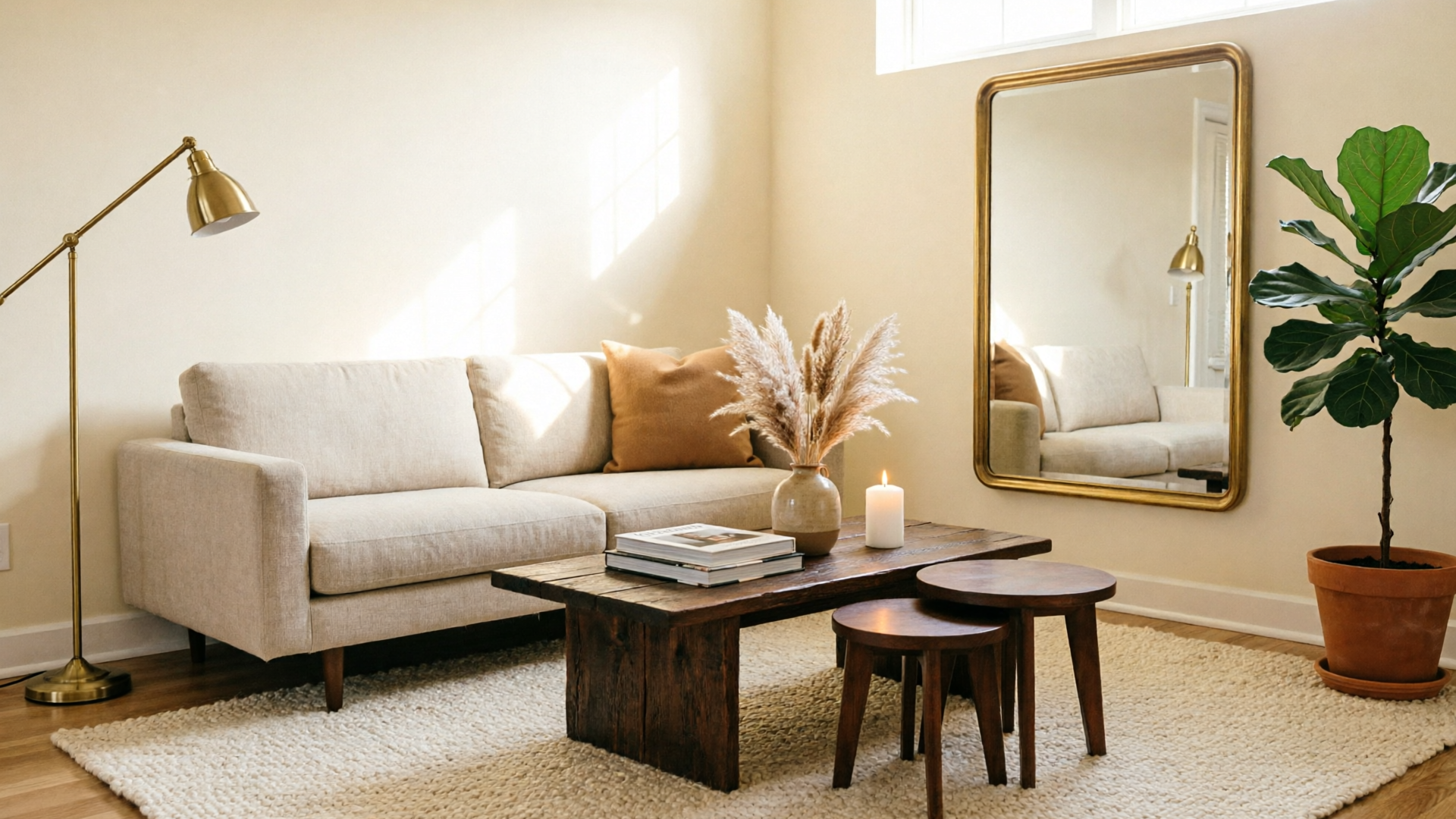
A sofa that sits directly on the floor creates a solid horizontal block that dominates a small room. A sofa with visible legs — even low, slender ones — allows light to pass beneath it, which makes the floor feel more continuous and the room feel larger.
The effect is subtle but real. When you can see floor beneath a piece of furniture, the room reads as having more space than it does. This applies to chairs and side tables as well.
Look for sofas with clean-lined legs in wood or metal, and keep the leg height proportionate to the sofa size — you’re not looking for something that looks precarious, just something that lets a little light through.
Nesting Tables Instead of a Large Coffee Table
A large coffee table in a small living room does the same thing as a large sofa on the floor — it creates a solid visual mass in the center of the room that makes the space feel smaller and harder to navigate.
Nesting tables are the smarter alternative. Two or three tables of slightly different heights that tuck together when not in use give you the surface area you need without the permanent footprint. When guests come, spread them. When it’s just you, nest them and reclaim the space.
The visual lightness of nesting tables — usually designed with slender legs and a modest profile — also keeps the center of the room open, which makes the whole space feel more breathable.
Mirrors: Placement for Maximum Light and Space
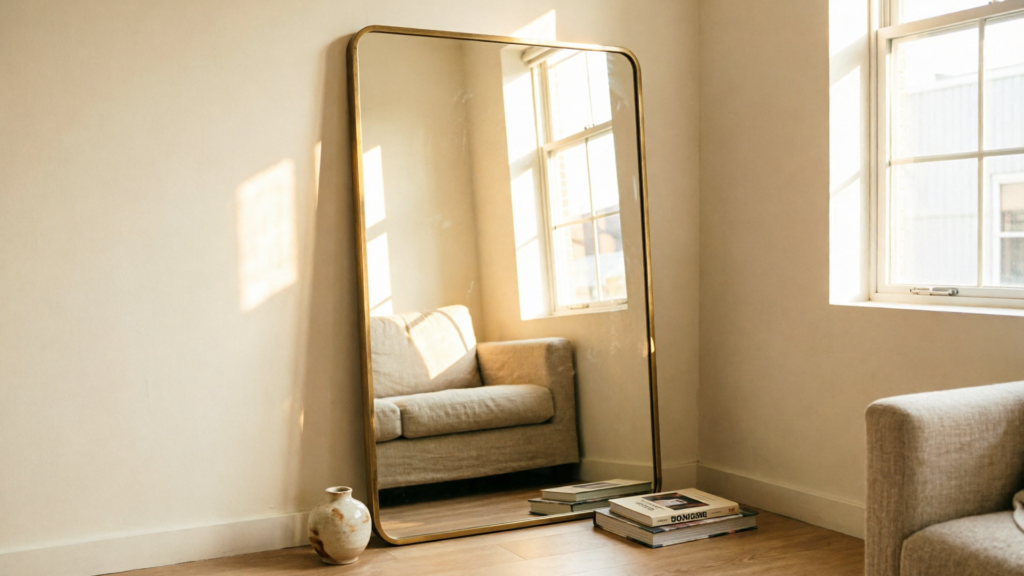
A well-placed mirror in a small room does something close to magic: it doubles the apparent depth of the space and bounces natural light into areas that would otherwise be dim.
The key is placement. A mirror hung across from a window or at an angle that catches natural light will multiply that light throughout the room. A mirror hung on a dark wall with nothing to reflect just shows you the dark wall in duplicate — which is not the effect you’re after.
Lean a large mirror against the wall rather than hanging it, and the effect feels less deliberate and more editorial. A round mirror over a console or fireplace creates visual softness that a rectangular frame doesn’t.
Multi-Functional Pieces
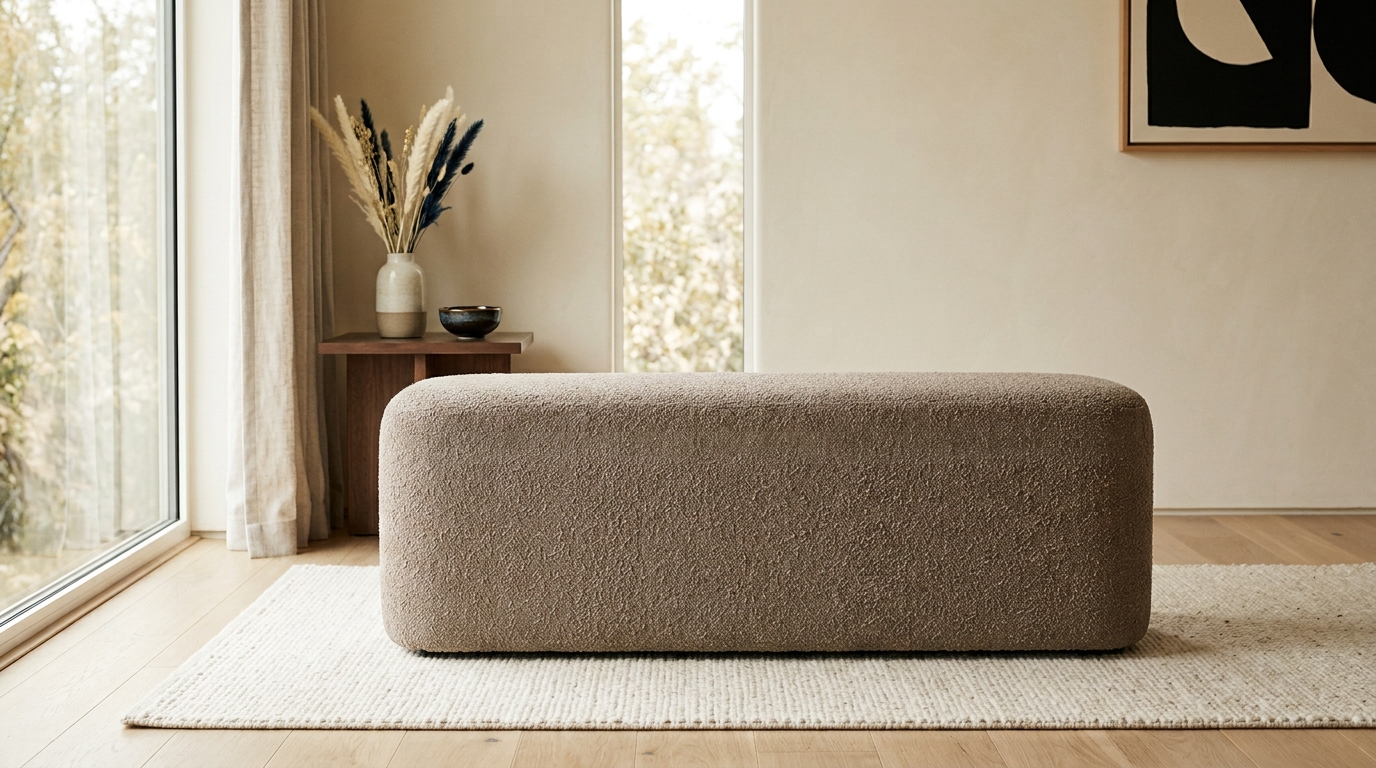
In a small space, a piece that does two things is worth significantly more than a piece that does one. An ottoman with storage inside earns its place as a coffee table, extra seating, and a place to put the blankets you’d otherwise leave draped over the sofa. A bench at the end of the sofa serves as additional seating, a surface for books or a tray, and a visual counterweight to the main furniture grouping.
The trick with multi-functional pieces is to choose ones that don’t look multi-functional. The ottoman should look like a beautiful piece of furniture, not a storage solution. When a practical piece is also a beautiful piece, the small room wins twice.
Color and Light Strategies
Furniture and layout do the structural work. Color and light do the atmospheric work — and in a small room, atmosphere matters enormously.
Light, Warm Neutrals on Walls
The conventional advice for small rooms is to paint them white. The better advice is to paint them a warm neutral — ivory, warm white, oatmeal, a very soft greige — that reflects light without the harshness that bright white can create.
Cool whites and bright whites can actually make a small room feel smaller by creating high contrast with darker elements in the room. A warm, slightly tinted white absorbs light gently and creates a cocoon effect that feels comfortable rather than clinical.
A single color throughout — walls and ceiling the same tone, or very close — eliminates the visual “box” effect that a contrasting ceiling creates. In a small room, painting the ceiling the same color as the walls makes the room feel taller.
Maximize Natural Light: Sheers Over Heavy Drapes
Natural light is the single most effective tool for making a small room feel larger, and heavy window treatments are its biggest enemy. Curtains that block natural light, drapes that bunch in front of windows, blinds that are perpetually half-closed — all of these shrink a room visually in ways that no amount of clever furniture arrangement can undo.
In a small living room, hang sheer curtains if privacy allows. Mount curtain rods close to the ceiling and let curtains fall almost to the floor — this elongates the window and makes the room feel taller, even when the window itself is modest.
The goal is to let as much light into the room as possible while maintaining a sense of softness. Sheer linen or cotton in ivory or warm white does this better than any other window treatment.
Warm Artificial Lighting: Lamps Over Overhead
Overhead lighting — a single ceiling fixture or recessed cans on full — is the quickest way to flatten a room and make it feel smaller. It casts light from one direction, eliminates shadow, and removes the sense of depth that makes a room feel three-dimensional.
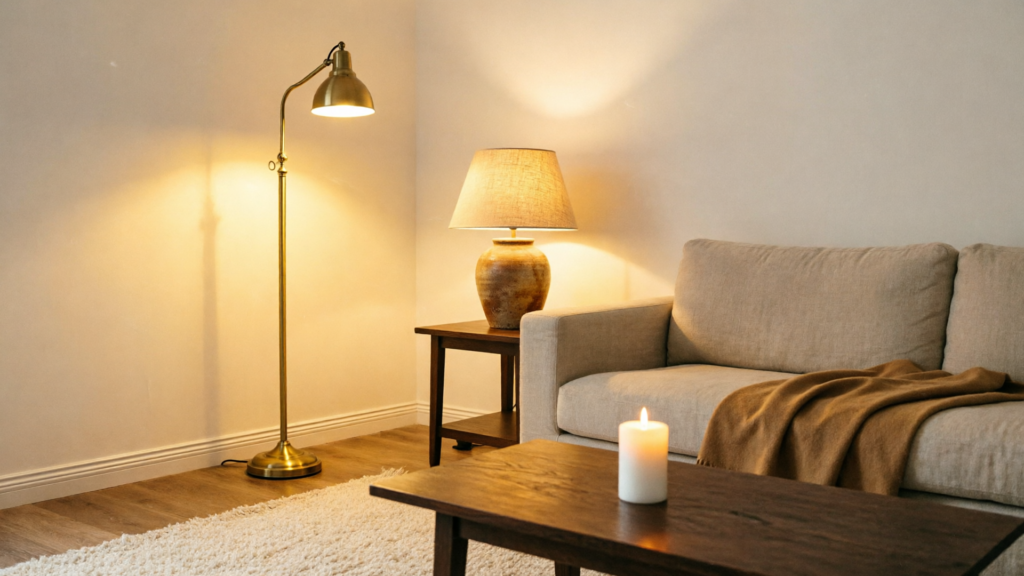
The solution is layered lighting from multiple lower sources: floor lamps, table lamps, and candles. These create pools of warm light at different heights throughout the room, which adds visual depth and creates a sense that the room is larger than it is.
Warm bulbs are non-negotiable — 2700K is the sweet spot for living rooms. Dimmers on every switch give you full control over the atmosphere at different times of day.
The One-Room Rule
Before we get to the shopping, one more thing worth saying: a curated small living room is a finished room. Not a room that’s waiting for more furniture, more objects, or more decoration. Finished.
The temptation is to keep adding — a new throw pillow here, another plant there, a second piece of art on that bare wall. Sometimes those additions improve the room. More often, they add noise to something that was already working.
When a small room feels right, stop. Resist the urge to fill the spaces that feel empty. Those spaces are doing exactly what they’re supposed to do.
Shop the Look: Small Living Room Edit
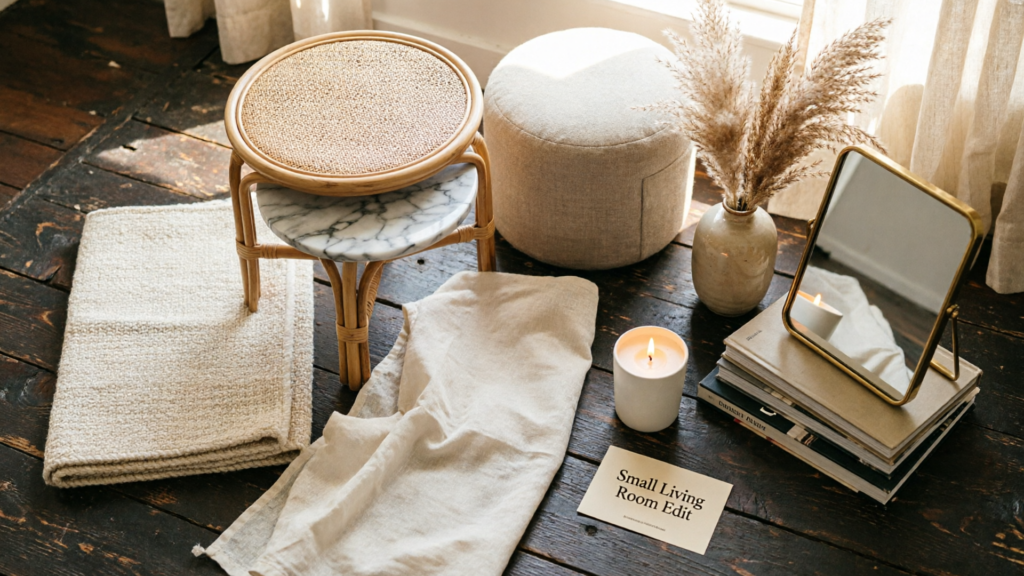
These are the pieces that work hardest in a small living room — chosen for visual lightness, dual function, and the kind of quiet quality that makes a small space feel intentionally curated rather than compromised.
The Sofa: Look for a clean-lined design with visible legs, in a neutral linen or boucle. Seat depth under 35 inches for smaller rooms. A two-seater or compact three-seater almost always looks better than squeezing in a full-size sectional.
The Rug: Go larger than feels intuitive. Natural fibers — jute, sisal, a flatweave wool — in warm neutrals that don’t compete with the furniture.
The Coffee Table Situation: Two nesting tables in rattan, marble, or metal with a slim profile. Or a single round ottoman in a textured fabric with a tray on top.
The Mirror: Large-format, leaned rather than hung if possible. Placed across from the best light source in the room.
The Lighting: One substantial floor lamp in a warm finish (brass, natural wood, black matte), plus one table lamp on a side surface. Linen or cotton shades for warm diffused light.
The Storage Piece: A bench with a hinged lid, upholstered in a neutral that works with the sofa. Positioned at the end of the sofa or under a window.
The Curtains: Floor-to-ceiling sheer linen panels in ivory or warm white, mounted 4–6 inches from the ceiling line, extending 6–8 inches wider than the window frame on each side.
A small living room, handled well, isn’t a consolation prize. It’s one of the most satisfying design challenges there is — because every decision matters, every choice is visible, and when you get it right, the room feels like it was designed exactly for the life you’re actually living in it.
Not cramped. Curated.
Shop the small living room edit and make every square foot count.
This post contains affiliate links. We may earn a small commission at no extra cost to you.